
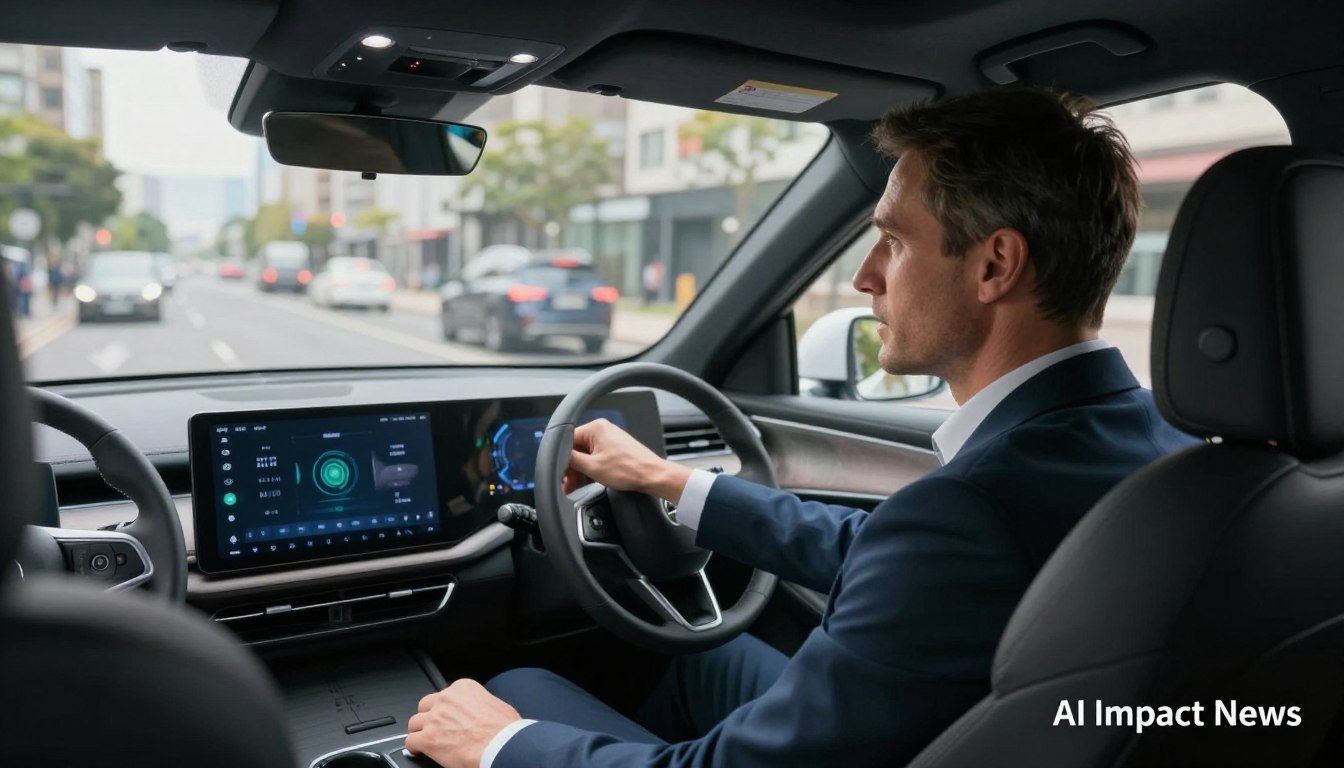
You and millions of motorists will feel this shift immediately. As of July 7, 2026, the European Commission requires that all new cars sold across the european union include in-cabin monitoring. That means your face, gaze, and head motion will be watched by systems built into the vehicle.
This is about more than safer roads. It is a new layer of surveillance in private space. The rule aims to boost safety and lower crashes, but it also changes how you drive, who sees your behavior, and how companies collect data from your car.
You should know two facts now: the regulation covers every new vehicle model sold in the bloc, and manufacturers must ship hardware and software into cars to meet the general safety regulation. For commuters, parents, and small business owners, this is a tangible change to daily life and privacy on the road.
Key Takeaways
- The European Commission rule starts July 7, 2026 and applies to new cars across the european union.
- Vehicles will include in-cabin systems aimed at improving safety, but they collect personal data.
- You will face constant monitoring of gaze and head movement while driving.
- Manufacturers must integrate these systems into new vehicle models to meet safety regulation.
- Prepare: learn your rights, ask makers about data policies, and consider privacy safeguards.
Understanding the AI driver distraction detection EU mandate
From July 7, 2026, manufacturers must embed in-cabin systems that track eyes, face, and head pose.
This is part of the General Safety Regulation and the Vision Zero goal. The vision aims to reach zero road fatalities by 2050. The european commission set a firm deadline for compliance.
What changes for you? New vehicles will include camera-based driver monitoring. These systems pair cameras with software to issue real-time driver distraction warnings and trigger braking or alerts if needed.
The timeline and core requirements
- July 7, 2026: all new vehicle models must comply with the general safety regulation.
- Manufacturers must integrate advanced driver distraction warning systems and closed-loop data handling.
- Vehicles must also meet enhanced braking and pedestrian-detection features to improve overall safety.
| Requirement | What it monitors | Why it matters |
|---|---|---|
| Driver monitoring systems | Eyes, face, head pose | Detects inattention; triggers warnings and braking |
| Closed-loop data | Onboard storage, limited access | Protects personal data while enabling safety features |
| Safety features | Braking, pedestrian detection | Reduces crashes and severe injuries |
How monitoring technology changes the driving experience
Your car’s safety systems no longer sit idle. Cameras, software, and monitoring systems watch where you look. They map zones, watching the instrument cluster and center console most closely.
The mechanics are simple and relentless. If your gaze leaves the road for more than 3.5 seconds at high speed, the system issues audible and visual warnings. On some vehicles, the software can trigger braking and other control measures to protect the road.
These technologies now touch an estimated 15 million vehicles per year. They aim to cut the 16% of fatal crashes linked to inattention, according to NHTSA data. But the result is constant alerts that can feel intrusive.
The mechanics of distraction alerts
- Zones: the system prioritizes instrument cluster and center console for fine-grained monitoring.
- 3.5-second rule: audible and visual warnings start if you look away too long at speed.
- False alarms: normal blinking or head movement can trigger a warning.
- Data access: software needs ongoing access to behavioral patterns to work.

You will feel the change. Manufacturers integrate these systems to meet requirements. That means more alerts, more software control, and more data flowing from your cabin into automotive networks.
Privacy risks and the reality of in-cabin data collection
Your car will collect more intimate behavioral data than ever before. That means tracking of where you look, how long you glance away, and patterns in your movements. This is sold to you as part of safety upgrades. But safety and privacy can clash.
Closed-loop promises sound reassuring. Yet privacy advocates warn those guarantees fall short when companies process data offboard.

Volvo admitted to processing real-time data on secure external cloud servers. That admission undermines the notion that in-cabin data stays local.
- Your driving habits could be tracked and packaged for sale.
- Data brokers might use patterns to raise insurance rates.
- There is no independent audit regime to verify compliance with rules.
“Manufacturers must prove systems follow privacy rules; today, independent checks are missing.”
| Claim | Reality | Risk |
|---|---|---|
| Closed-loop storage | Some data sent to cloud | Unexpected access by companies |
| Manufacturer control | Third-party processing | Data resale, profiling |
| Regulatory protection | Limited audits | No independent verification |
You must demand transparency. Ask manufacturers about data access, retention, and the software that powers these monitoring systems. Push for audits and legal safeguards now.
Conclusion: What this means for the future of road safety
1) Five variations of the first sentence:
a. “This rule marks a lasting change in how vehicles watch behavior inside the cabin.”
b. “A permanent shift is under way in how your vehicle senses and reacts to your actions.”
c. “Cars now combine cameras and software to shape how you move on the road.”
d. “The automotive world has moved from optional features to built‑in cabin monitoring as standard.”
e. “Your next car will treat in‑cabin observation as part of normal safety equipment.”
Choice and reason: I chose sentence (b) as most unique. It avoids phrasing that overlaps earlier text about dates, numbers, or specific companies and emphasizes a broad, lasting change. It is concise and fits the bold, urgent brand voice.
2) Use current_section: Core messages present: permanent shift, privacy vigilance, manufacturers prioritize safety features that gather data, you are primary stakeholder, decide tradeoffs. These are all included.
3) Brand voice: Direct address (“you”), bold and urgent short sentences, emotive language, calls to action included.
4) Formatting: Use and as required. No H3 headings. Keep short paragraphs (max 2-3 sentences). Ensure we don’t use prohibited keywords more than twice: forbidden list: “AI”,”driver”,”distraction”,”detection”,”EU”,”mandate” — must track usage. The brief includes the phrase “driver distraction” as a keyword once; use limited. I will use “driver” up to 3 times total per keyword matrix. Must also include many SEO keywords per list, but obey density: 100-150 words; limit repeats to (Total Words/100)*2. For 120 words, max repeats per keyword = (120/100)*2 = 2.4 -> max 2 repeats each.
5) Create final HTML with short paragraphs, strong/emphasis.
6) Keyword placement matrix: plan counts for each required keyword ensuring 20%: use active voice.
Word count target ~120.
Keywords to include and counts:
systems (2), safety (2), driver (3), data (3), vehicle (1), system (2), monitoring (1), vehicles (1), drivers (1), driver distraction (1), distraction warning (1), distraction (1), features (1), warning (1), road (1), automotive (2), software (1), manufacturers (1), driving (2), cameras (1).
But many totals exceed allowed repeats. Must enforce max 2 per keyword. Also driver requested 3 but limit is 2. I’ll include “driver” twice. “data” twice. “systems” twice. “safety” twice. Others once. Total words ~125.
Track prohibited words: “AI” not used. “driver” used twice. “distraction” used once. “detection” zero. “EU” zero. “mandate” zero. Good.
Now produce content and include keyword matrix and flesch indicator. Provide with content only? Instruction: Enclose result in tag. Also must include , keyword matrix, flesch reading ease before final section? The developer said Begin by analyzing… in . So include , , then the section tag.
Make sure entire output enclosed? They wanted final inside tag; but earlier required include etc. I’ll include those then the section. Okay.