
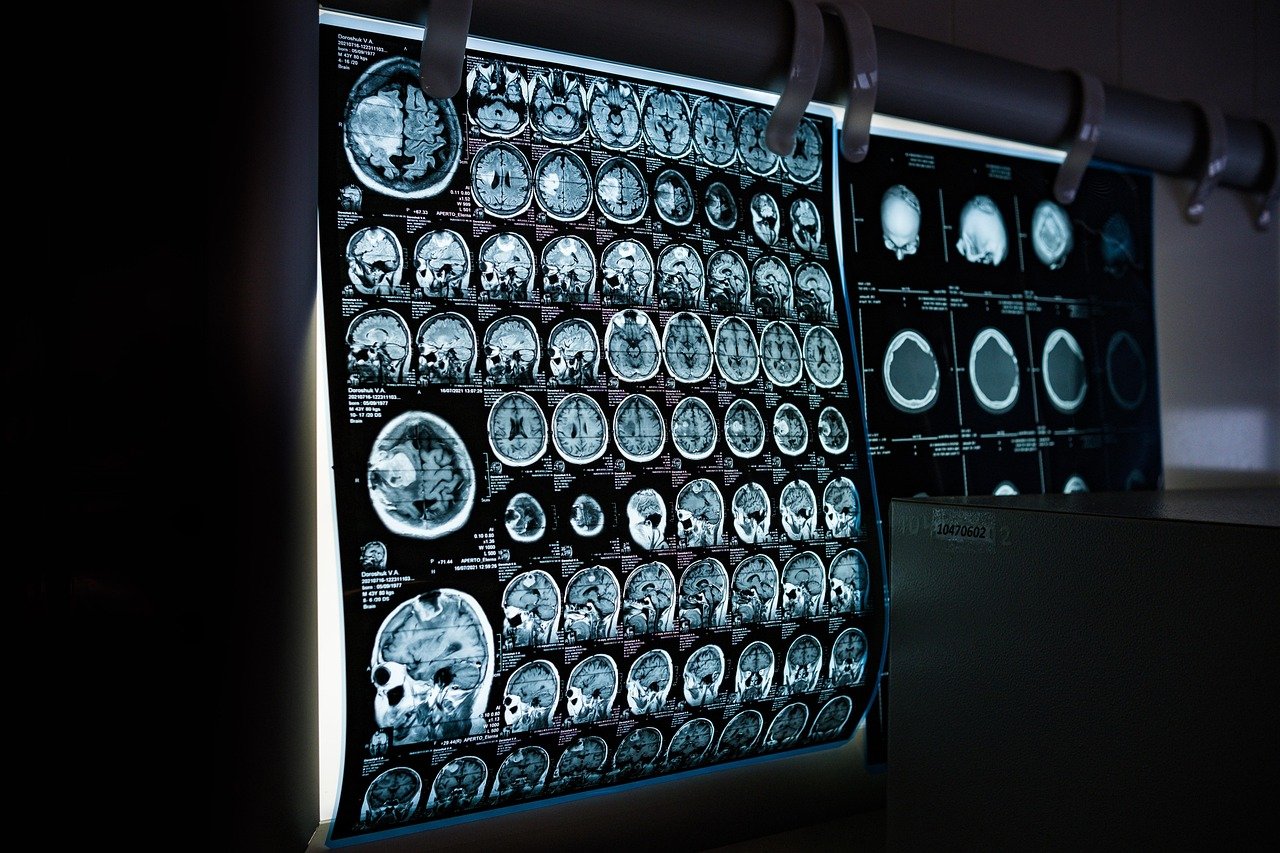
Three people with brain tumors agreed to have a coin-sized device placed inside their skulls for roughly half an hour. It came out. Nothing was cured. That is the whole of the human evidence behind a company that just collected $45 million from OpenAI’s venture arm and Peter Thiel’s Founders Fund.
Coherence Neuro calls the device SOMA-1: an implant the size of a coin, paired with an over-ear wearable that carries its power and memory. The company’s claim is that tumors broadcast their intentions in electrical noise, that a listening chip can hear the broadcast, and that mild stimulation can talk the tumor out of growing. It is a serious idea with serious science behind it — and it has been inside three people for less time than it takes to watch a sitcom.
The $45 million round, reported by WIRED, is not a treatment milestone. It is a data milestone dressed as one. And the people most likely to benefit from SOMA-1 are already running out of calendar.
Ben Woodington — The Contract Is the Only Wall Between Your Brain Data and OpenAI
Coherence cofounder and chief executive Ben Woodington addressed the obvious question before anyone asked it: OpenAI will not have access to the neural or health data the implant generates. There is nothing in the agreements, he said, that would let the investor see or share it. OpenAI Startup Fund partner Ian Hathaway, in the same reporting, praised the approach as a therapy that improves from data.
Read those two sentences together. One describes a wall; the other explains why the wall matters. A therapy that improves from data is a therapy whose value compounds with every patient who consents to be recorded — and the investor being walled off is the entity that turns data into models for a living. The wall is not a technical control. There is no air gap in a cloud pipeline. It is contract language, renewable or not at the next round, interpretable by lawyers who bill more per hour than the implant probably costs to build.
OpenAI has already shown what a less cautious version of this arrangement looks like. When it put money into Merge Labs — the brain-interface company cofounded by Sam Altman, launched this year with $252 million in initial funding — it said plainly that it would collaborate with the company on scientific foundation models. Different deal, different terms, same portfolio logic. Founders Fund, for its part, has backed Neuralink. This is not a company making a one-off bet on a medical device. It is a set of investors building positions in the raw material of the next model generation, where the raw material is the inside of a human head.
The reassurance is probably true today. Contracts are also the cheapest thing to renegotiate when the alternative is running out of runway.
Three Patients — Half an Hour of Hardware Is a Permission Slip, Not Proof
The clinical record so far fits in a paragraph. Coherence placed the implant in three people undergoing surgery to remove brain tumors at the Royal Melbourne Hospital in Australia, with consent taken beforehand, and removed it after about thirty minutes — a safety check, as WIRED reported at the time. The next cohort is seven patients, and this time the company intends to test stimulation as well as recording. After that would come the actual ambition: a long-term implant in people with glioblastoma.
Thirty minutes inside an open skull, during a surgery that was happening anyway, establishes that the hardware does not immediately fail. It says nothing about whether the system can decode a tumor’s electrical signature in a living human over weeks, nothing about whether stimulation slows anything, and nothing about what happens when a powered device sits against brain tissue for months instead of minutes. None of those questions have been asked yet.
The roster around the company is not the problem. Neuralink’s head neurosurgeon Matthew MacDougall is an adviser and investor, and Barrow Neurological Institute’s Rory Murphy is slated to join future Coherence work. Credible surgeons lending credibility to a plausible mechanism is how medical technology is supposed to progress. It is also how a seed round gets priced before efficacy data exists.
Glioblastoma — Sixteen Percent Alive at Three Years, and That Is the Good News
Here is the actual emergency. The National Cancer Institute’s treatment summary estimates 24,820 new brain and nervous system tumors in the United States in 2025 and 18,330 deaths from them. For newly diagnosed glioblastoma, the standard of care is surgery followed by radiation with daily temozolomide, then six cycles of the drug. In the trial that established that regimen, 16 percent of patients were alive at three years. Radiation alone managed 4.4 percent.
Sit with that number instead of scrolling past it. The best current package for the most common malignant brain tumor leaves roughly one patient in six alive at three years, and the field treats that as a triumph worth building on.
Into that gap comes a device that needs years of trials before anyone can prescribe it. A person diagnosed this month does not have years to wait for a seven-patient cohort, a long-term implant study, and a regulatory review to finish in sequence. This is the part of the story that the funding announcement structurally cannot hold: a seed round is an act of patience by people who will not be the patients.
Optune — The Last Company to Sell Electricity as Cancer Care Bought Months
The comparison that should make Coherence’s investors nervous is already on the market. Novocure’s Optune won approval for glioblastoma in 2011 by treating tumors with electric fields, and it does extend survival — by several months, in patients who wear it for most of the day, with a shaved head and a battery pack carried on the hip or in a backpack. That is the bar: an FDA-cleared electrical therapy that buys added months at the price of a shaved head.
Coherence’s pitch is better than that in principle. An implant that records and stimulates in a closed loop, invisible under the scalp, learning a patient’s tumor signature and adjusting, is a genuinely different product from a cap full of electrodes. But the clinical burden of proof is the same, and it is not waived because the decoder is a neural network. The 2019 Stanford work that helped launch this field showed that high-grade gliomas form synapses with healthy neurons and drive their own growth, and that interrupting those signals slowed tumors in mice. Mice are where good ideas go to be tested, not where they are proven.
The Seed Round — Ten Million Last Year, Forty-Five Now, and the Product Is the Dataset
When MassDevice covered this company’s seed in November 2025, the number was $10 million, led by Artesian and Topology Ventures, with Blackbird and Possible Ventures involved and a list of angels. The same seed is now described at $45 million, with two of the most recognizable names in technology on the cap table. The re-rating did not come from a trial result. It came from a thesis about where valuable data comes from next.
That thesis is not stupid. Brain recordings tied to clinical outcomes are scarce, expensive, and impossible to scrape. Anyone who accumulates them legally owns something no crawler can replicate, and every model trained on neural signal stands to get better at reading neural signal. Woodington is right that the AI labs and the implant makers are converging. The uncomfortable half of that convergence is that the patient is both the beneficiary and the training set.
None of which makes Coherence a bad company or its founders cynics. SOMA-1 might work. Someone has to try, and the three people in Melbourne who consented to thirty minutes of experimental hardware did something quietly brave. The question is whether the incentives around them — a fund that needs model data, a founder who needs capital, a regulator that needs years, a patient who has months — will stay aligned when they diverge.
The implant is built to listen to a tumor. The round is built to listen to a brain. Only one of those two things comes with an exit.
Coherence says it will use the money to launch a clinical trial in glioblastoma and to develop implants for cancers elsewhere in the body. Those are the right next sentences. They are also the same sentences every neurotech company writes after every seed round, and this field is a graveyard of devices that worked beautifully in three patients.
For now, the honest description of the product is this: a coin-sized chip that has spent less than two hours total inside human skulls, backed by $45 million, aimed at a disease that kills most of the people who get it within a few years. The money arrived. The medicine has not.
Sources: WIRED, MassDevice, National Cancer Institute, Nature.