
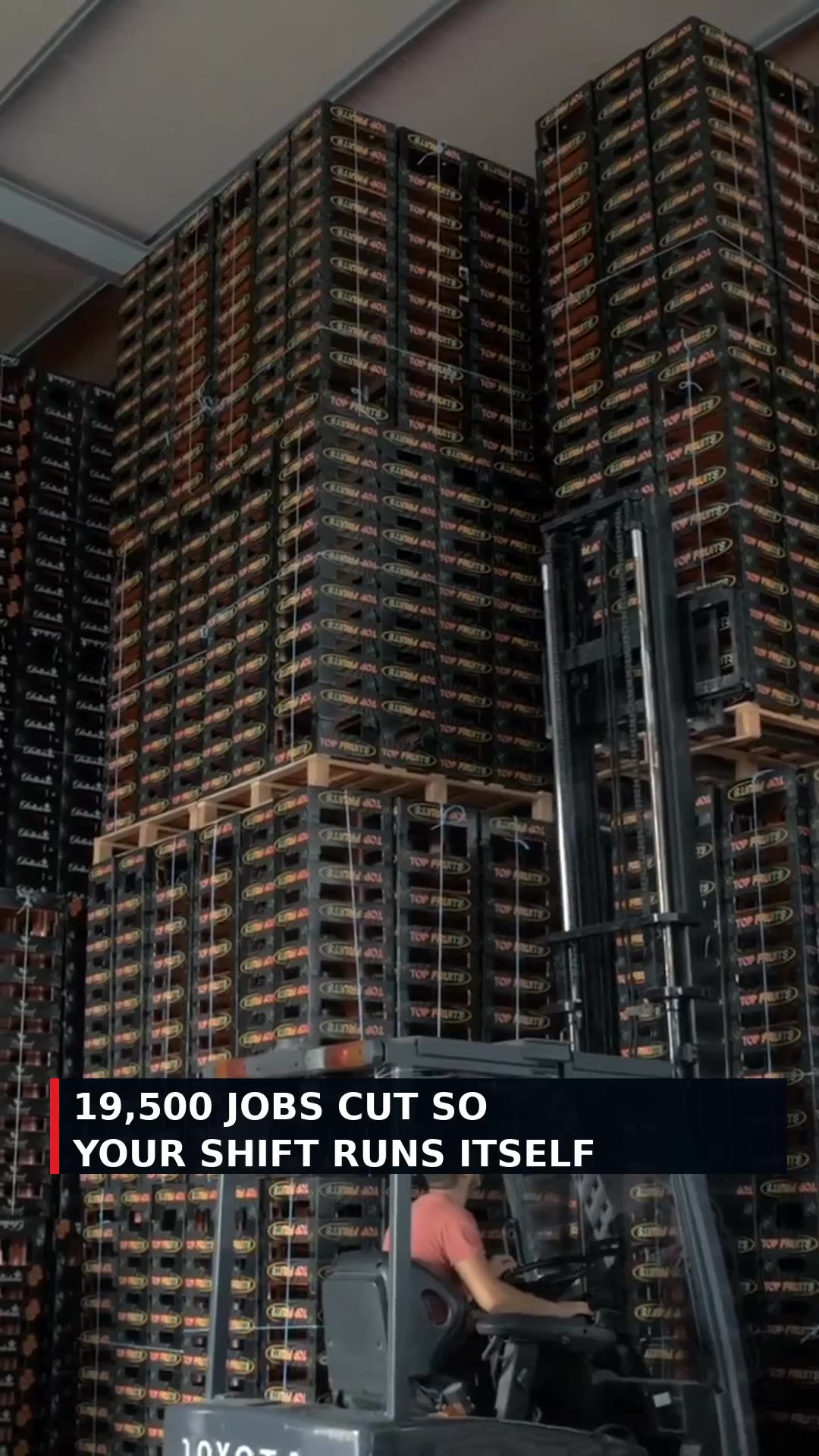
Procter & Gamble layoffs stopped being a forecast on Thursday, November 19, and became a percentage in an investor deck: 20 to 30 percent of its product-supply workforce, contractors included, gone by 2030. On roughly 65,000 people, that is somewhere between 13,000 and 19,500 jobs, and the same presentation explained exactly how the work will get done without them — fifteen factories that already run whole shifts with nobody in the building, more coming in 2027. The company did not hide this. It said it out loud, to investors, in Cincinnati, in the same hour it announced the savings. Disclosure is not decency. It is just better bookkeeping.
That is the entire story in one paragraph, and it deserves to be read twice. A consumer goods giant that sells Tide, Gillette and Pampers has worked out how to make and move its products with fewer humans, has priced the benefit at up to $10 billion, and has given the people who used to do the work seven years to find somewhere else to be.
Procter & Gamble Layoffs — The Overnight Shift Was Always the Test
The unattended shift is not a concept drawing on a slide. P&G ran its first one at a Gillette plant in Berlin in 2024, and that site now runs the overnight shift without technicians — the shift nobody wanted to staff, which is precisely why it was the first to be handed over. Fifteen sites can now operate unattended for hours at a time, mostly overnight, with more added next year, The Business Times reported from the New York Times’ account of the investor day. Autonomous robots work the loading docks and warehouses. Driverless trucks have been tested.
Luc Reynaert, the chief product supply officer, told the room that unattended operations would lift manufacturing productivity by as much as 20 percent over four years, and framed the gain as freeing employees for higher-value work. Both halves of that sentence can be true. The remaining workers get better schedules and less repetitive tasks, and there are fewer of them. Leaner teams, the company conceded, is the direction of travel — and Bloomberg counted fifteen unattended logistics sites and roughly 52,000 manufacturing employees across about 35 countries as of a May 2025 filing, Quartz reported, close to half of everything P&G employs.
Do the arithmetic on the company’s own framing and it stops being flattering. Productivity up 20 percent. Headcount down 20 to 30 percent. The people are being cut faster than the output is being gained, which is a margin story wearing a productivity costume.
Luc Reynaert — Three Promises for 2030, and Only One of Them Has a Face
Reynaert set the workforce reduction beside two other 2030 commitments: up to $1.8 billion in annual productivity savings, and free cash flow productivity of 90 percent or better, as StockAnalysis recorded from the presentation. The $1.8 billion comes out of the cost of goods sold — which is another way of saying it comes out of the people who make the goods. One of the three promises has names attached to it. The other two have decimal points.
The cuts are not new and they are not sudden, which is the part that should worry anyone hoping this is a blip. A company spokesperson said the reductions have been running for several years inside Supply 3.0, P&G’s supply-chain program, which, per The Wall Street Journal’s description carried by Quartz, aims to hold supply steady while pushing more digital and automated processes into operations, retraining workers on the new tools and improving sustainability. Seven years, one program, one direction. Nobody at that investor day was pretending otherwise.
Andre Schulten — $10 Billion in Savings and No Line Item for the Landing
Chief financial officer Andre Schulten raised the frame to as much as $10 billion in productivity savings across fiscal 2027 through 2030, Reuters reported from the same event, with the $1.8 billion drawn from the cost of making the products. His stated purpose was reinvestment, so P&G can grow faster than its markets. Chief executive Shailesh Jejurikar pitched the company as the consumer packaged goods company of the future, citing a database of 10 million consumer profiles and heavier use of AI to speed up its processes. That is the vision. The measurable feature of it is a smaller payroll.
What P&G did not present was a number for where the 13,000 to 19,500 people go. No severance line, no retraining target, no redeployment count. The company that can model a supply chain to the shift cannot model the other side of the transaction, or has decided it is not the company’s line to model. The spreadsheet is excellent. The exits are somebody else’s department.
Josh Bivens — The Economist Who Isn’t Losing Sleep Is Telling You to Build the Net
Josh Bivens, chief economist at the Economic Policy Institute, told the Times that unattended factories are not the thing that keeps him up at night, because once a company starts upgrading a line it is very hard to stop. His prescription was not reassurance but policy: the United States should strengthen the social safety net for workers displaced by this kind of advance. Read that carefully. The expert calm is not a claim that the jobs survive. It is a claim that the transition cannot be prevented, so the country had better pay for the landing.
Shawn Fain, president of the United Auto Workers, said the plainer version at the union’s convention in June, calling robots replacing people in factories a profound threat. He is not wrong, and he is not early. He is watching P&G do in white goods and toothpaste what the automakers did in Michigan first.
Brian Jacobsen — Cost Cutting Can Protect Profitability, It Cannot Manufacture Growth
Brian Jacobsen, chief economic strategist at Annex Wealth Management, asked the question the investor deck slides past: how much of that $10 billion is genuinely new efficiency, and how much is offsetting higher energy and freight costs the company already warned would bite into profit. His verdict was that cost cutting can protect profitability but cannot manufacture growth, and that he would wait for proof that P&G can shrink its workforce without sacrificing innovation, service levels or execution. That is not hostility. That is a man reading the same three promises and noticing that only the reduction is unconditional.
He is right to wait. Every large employer in this cycle has discovered that a headcount target is the one number management can hit in a downturn without asking anyone’s permission. Engineers, planners, quality inspectors and purchasing staff are not line items that come back when demand does.
The 65,000 — P&G Named a Percentage, Not One Person
Product supply is the part of P&G that makes and moves the goods, and the roles inside it are the middle of a working life: manufacturing, purchasing, planning, engineering, quality control. A quality inspector in Ohio with nineteen years on the line, a planner in Cincinnati who knows which supplier slips in December, a purchasing lead in Singapore holding a relationship that took a decade to build. None of them are in the presentation by name. They are in it as a percentage range, which is the most efficient way to describe a reduction and the least human way to describe a person.
This sits on top of the up to 7,000 office and non-manufacturing jobs P&G said it would remove in June 2025 and still says it will, per StockAnalysis’ summary of the same investor event. Two rounds, eighteen months, one company, and the second round announced as a productivity commitment while the first is still being executed. The pattern is not a supply-chain program. It is a company teaching itself to run smaller and calling each lesson a target.
Axel’s take: P&G has done something most employers avoid and told the truth on the record, and the truth is worse than the euphemism would have been. Twenty percent productivity against a thirty percent headcount cut is not automation freeing people for higher work. It is a company deciding that the workers it cannot fully replace are still, on average, more expensive than the ones it can. The Berlin overnight shift is the proof of concept and the rest of the portfolio is the rollout, and the rollout runs to 2030 — long enough for every one of those 65,000 people to hear the number, do their own arithmetic, and start looking. Some will land well. The ones who do not will be told the transition was inevitable, which is true, and that they should have prepared, which is a sentence written by people whose own jobs were never on the list. The genie did not escape the bottle this time. It was handed a shift schedule.
Sources: The Business Times (New York Times), Reuters, Quartz, StockAnalysis.
More on this: 850 Jobs Cut So Qantas Can Buy the AI It Cannot Hire · Microsoft Layoffs: Voluntary Exit Offer Goes to 60,000 Employees · Game Industry Layoffs: 54% Still Jobless as AI Use Hits 40%